Neurodevelopmental Science
The Neurodevelopmental Science Behind Autism
How visual pathways, motor development, and attentional systems interact within the nervous system.
This section explains how visual pathways, motor development, and attentional systems interact within the nervous system.
Development Begins With Movement
Development begins with motor organization. Infant reflexes and early movement patterns help the brain establish coordination between the body, the sensory systems, and spatial awareness.
Motor development typically progresses through:
- Reflex patterns
- Gross motor coordination
- Fine motor control
- Ocular motor coordination
Because eye movements are part of the body's motor system, stable visual attention depends on the successful organization of earlier motor systems.
When early motor development is interrupted, ocular motor coordination may still be organizing.
Ocular Motor Coordination and Binocular Vision
Eye movements are controlled by cranial nerves that originate in the brainstem.
Cranial Nerve III
Oculomotor
Controls most eye muscle movements.
Cranial Nerve IV
Trochlear
Controls downward and inward eye movement.
Cranial Nerve VI
Abducens
Controls outward eye movement.
These nerves coordinate the muscles that allow both eyes to align with the same visual target.
When both eyes align successfully, the brain merges the two images into a single perception. This process is called binocular fusion. Binocular vision allows the brain to construct a stable spatial representation of the world.
When binocular coordination is unstable, central fixation may require significant neurological effort. From the ICONIX perspective, this may lead to central field neglect, which is often observed in autism.
Retinal Ganglion Cells and Visual Information
Visual information enters the brain through specialized retinal neurons called ganglion cells. These cells transmit signals through two major pathways:
Magnocellular System
- Sensitive to motion
- Fast signal transmission
- Spatial awareness
Parvocellular System
- Sensitive to detail and color
- Slower signal transmission
- Object recognition
Dorsal and Ventral Visual Streams
After visual signals leave the retina, they travel to the occipital cortex at the back of the brain. From there, visual information divides into two major processing pathways.
Dorsal Stream “Where / How”
Processes motion and spatial relationships.
- Where objects are located
- How the body should move
- How movement interacts with space
- Magnocellular input → parietal cortex
Ventral Stream “What”
Processes detailed visual information.
- What an object is
- What a face represents
- What symbols mean
- Parvocellular input → temporal cortex
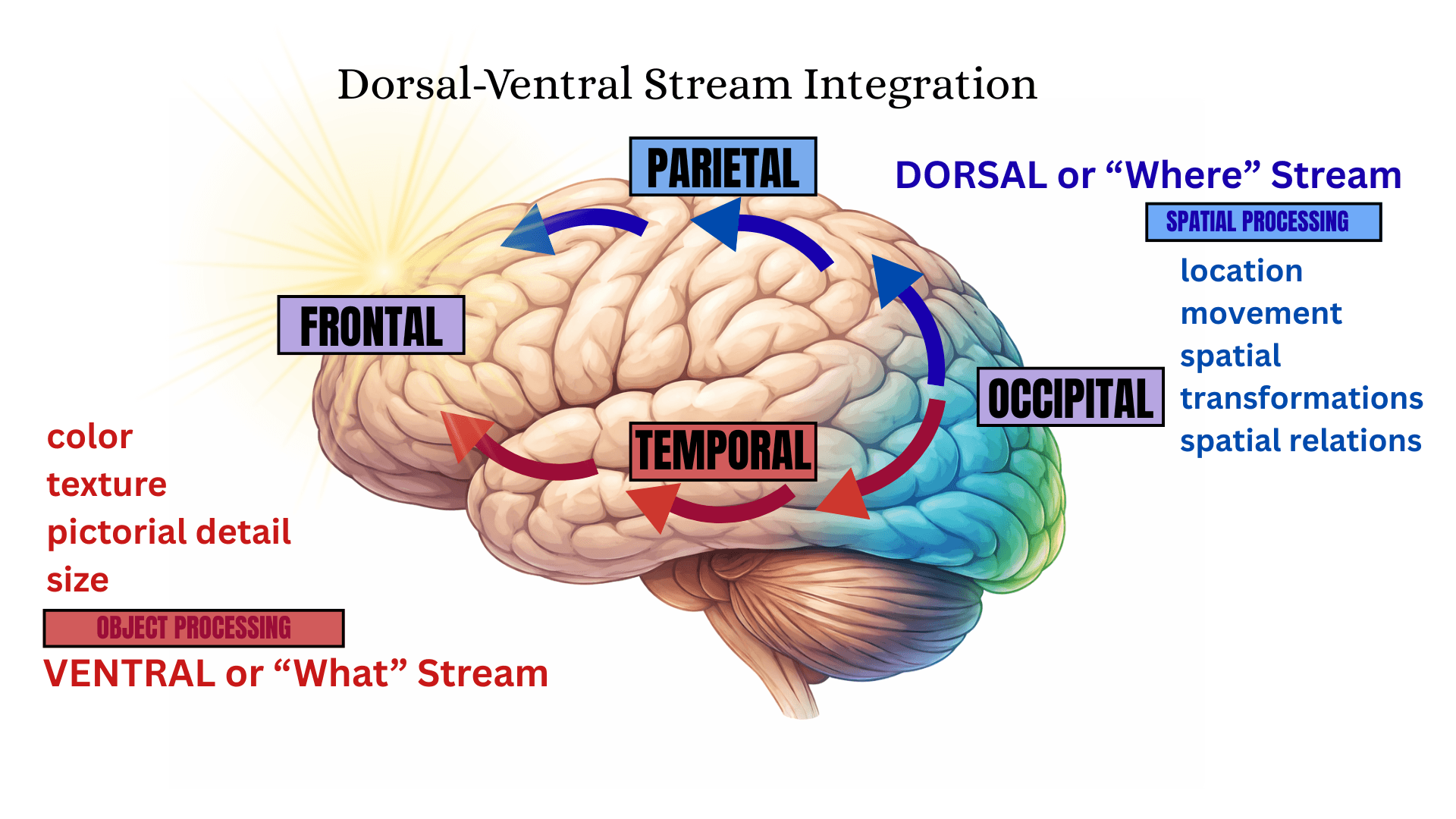
Visual information enters through the retina, travels to the occipital cortex, and divides into two pathways. The dorsal stream processes motion and spatial information, while the ventral stream processes object recognition and symbolic understanding.
Attentional Distribution in Autism
When binocular coordination is difficult, the nervous system may rely more heavily on motion signals from the magnocellular pathway.
This strengthens dorsal-stream processing while reducing reliance on ventral-stream symbolic processing.
This difference in attentional distribution may influence:
- Sensory preferences
- Visual attention
- Imagery formation
- Language development
Imagery and Language
When visual information travels successfully through the ventral stream, the brain can form stable internal representations of objects and faces.
These representations support visual imagery within the mind. Imagery allows the mind to recall and manipulate visual information even when the object is not present.
Because the ventral stream connects closely to language networks in the temporal cortex, reduced ventral-stream processing may influence symbolic processing and speech development.
Returning to the Developmental Framework
- 1
Motor Development
- 2
Ocular Motor Coordination
- 3
Binocular Vision
- 4
Attentional Distribution
- 5
Visual Processing Pathways
- 6
Imagery Formation
- 7
Language Development
Each layer builds upon the stability of the previous system.
From the ICONIX perspective, autism can be understood as a difference in how these systems organize perception and attention during development.